Artificial intelligence is reshaping the modern contact centre. What used to be seen as a cost centre is quickly becoming a strategic growth engine, powered by smarter automation, predictive insights, and real-time support for both customers and agents. When done right, AI in the contact centre does more than reduce queue times; it elevates the entire customer experience while lowering operational costs and increasing employee satisfaction. Transforming call centers with AI is no longer optional—it’s becoming essential for businesses that want to stay competitive.
To truly harness the potential of AI, organizations need to understand not only the technology but also the ecosystem around it. Emerging solutions like high-performance computing for AI applications allow contact centres to process complex data faster, giving agents actionable insights in real time. Meanwhile, exploring supercomputing solutions for large-scale operations can help businesses handle higher call volumes without sacrificing service quality.
Marketing and customer engagement strategies are equally important for modern contact centres. Using platforms that focus on effective customer marketing campaigns ensures that AI-driven insights translate into meaningful interactions. Similarly, agencies that specialize in innovative digital marketing strategies can amplify your brand’s presence while complementing automated contact centre tools.
For financial and resource management, leveraging top financial resources for business growth can help organizations allocate budgets efficiently, ensuring AI investments deliver maximum ROI. By connecting technology, marketing, and financial planning, businesses can create a seamless, AI-enhanced experience that benefits both customers and staff alike.
As AI continues to evolve, adopting a holistic approach that includes the right infrastructure, strategic marketing, and smart financial planning will define the leaders in the modern contact centre landscape. The future is about combining human creativity with AI-powered efficiency, giving every customer interaction more value.
Top 10 AI in the Contact Centre Platforms
Artificial intelligence is transforming how businesses operate their contact centres, enabling faster responses, personalized experiences, and more efficient operations. Choosing the right platform can make all the difference in improving customer satisfaction and reducing operational costs. Here are the top 10 AI in the contact centre platforms currently leading the industry.
1. Bright Pattern
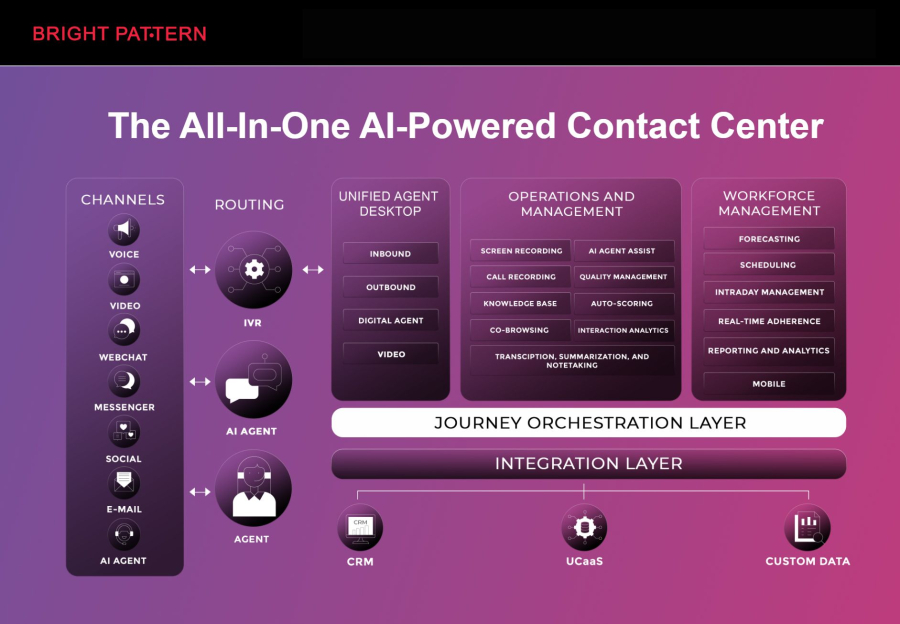
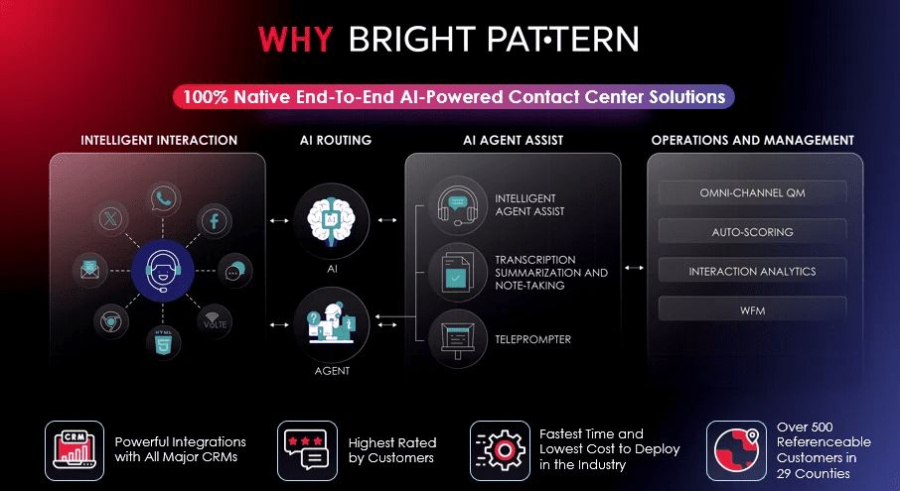
Bright Pattern stands out as a complete solution for businesses looking to leverage AI in the contact centre. It combines intelligent automation, omnichannel support, and real-time analytics to help agents deliver exceptional customer experiences.
Key features include:
- Omnichannel routing for seamless customer interactions
- AI-powered chatbots and virtual assistants
- Real-time agent guidance and coaching
- Predictive analytics to forecast call volumes and customer needs
- Easy integration with CRM and business tools
Bright Pattern’s AI capabilities allow contact centres to reduce wait times, increase first-call resolution, and optimize agent performance, making it a top choice for companies aiming to modernize their customer service.
2. Genesys Cloud CX
Genesys Cloud CX offers a robust platform that combines AI and workforce optimization tools. Its predictive routing and AI-powered chatbots help deliver personalized experiences across voice, chat, and social channels.
3. Five9
Five9 focuses on AI-driven automation to enhance agent efficiency and customer satisfaction. Features include intelligent call routing, predictive dialing, and AI analytics to improve contact centre performance.
4. NICE inContact CXone
NICE inContact CXone provides a cloud-based solution integrating AI to optimize customer interactions, automate repetitive tasks, and give agents real-time assistance for more efficient handling of customer inquiries.
5. Talkdesk CX Cloud
Talkdesk CX Cloud leverages AI to enhance omnichannel communication, using machine learning to predict customer behavior and assist agents with relevant information during interactions.
6. Avaya OneCloud
Avaya OneCloud combines AI and automation to improve operational efficiency, offering chatbots, analytics, and predictive engagement tools to ensure higher customer satisfaction.
7. Zendesk AI
Zendesk AI integrates intelligent automation into its support platform, providing AI-assisted ticketing, chat, and self-service solutions that streamline the workflow for agents and customers alike.
8. 8x8
8x8 leverages AI-driven tools to optimize contact centre operations, providing advanced call analytics, routing, and automated customer support to improve service quality and agent efficiency.
9. RingCentral
RingCentral offers cloud-based contact centre solutions with AI integration, including virtual assistants, smart routing, and real-time performance insights to deliver seamless customer experiences.
10. Cisco Contact Center AI
Cisco Contact Center AI uses advanced machine learning to enhance agent efficiency, automate common inquiries, and provide real-time support insights, helping companies deliver faster and more accurate service.
What Do We Mean by "AI in the Contact Centre"?
AI in the contact centre refers to a set of technologies that simulate aspects of human intelligence to improve service, efficiency, and decision making. These typically include:
- Natural language processing (NLP)to understand customer queries in everyday language.
- Machine learning (ML)to detect patterns, predict outcomes, and continually improve performance.
- Conversational AIsuch as chatbots and voicebots that can manage end-to-end interactions.
- Agent assist toolsthat surface guidance, knowledge, and next-best actions in real time.
- Analytics and quality automationthat evaluate customer sentiment, compliance, and experience at scale.
Collectively, these capabilities help contact centres handle more interactions, at higher quality, with fewer manual tasks holding teams back.
Why AI Is a Game Changer for Contact Centres Right Now
Several trends are converging to make AI not just appealing, but practically essential for modern contact centres.
- Rising customer expectations.Customers expect 24/7, instant, personalised support across channels.
- Growing interaction volumes.Digital channels, from chat to social messaging, have exploded in volume and complexity.
- Talent and cost pressures.Hiring, training, and retaining agents is costly and challenging in many markets.
- Better AI accuracy.Advances in NLP and ML have significantly improved AI understanding of human language and intent.
AI lets contact centres keep pace with these demands without endlessly adding headcount or sacrificing quality.
Core AI Use Cases in the Contact Centre
AI is not a single feature; it is a portfolio of capabilities that can be applied across the customer and agent journey. Below are the most common and impactful use cases.
1. Intelligent Self-Service: Chatbots and Voicebots
AI-powered virtual assistants can handle a large share of routine enquiries, such as order status, password resets, or appointment scheduling. They use natural language understanding to interpret what the customer wants and respond conversationally, often resolving the issue without an agent.
- Benefits for customers:Always-on availability, instant responses, and consistent information.
- Benefits for the business:Lower cost per contact and reduced pressure on queues during peak times.
- Benefits for agents:Fewer repetitive tasks and more time to focus on high-value, complex conversations.
2. Smart Routing and Triage
Instead of relying only on IVR menus or simple skills-based routing, AI can analyse the customer message, sentiment, and context to decide where to send the interaction.
- Intent detectionidentifies what the customer is trying to achieve.
- Sentiment analysisflags urgency or frustration.
- Predictive routingcan match customers with the best available agent based on skills, history, or performance patterns.
The result is faster resolutions, fewer transfers, and a smoother experience for the customer.
3. Real-Time Agent Assist and Co-Pilots
AI can assist agents during live calls or chats by listening, reading, and analysing interactions in real time. It then offers helpful prompts and shortcuts.
- Suggested responsesand templates tailored to the customer’s query and history.
- Knowledge recommendationsthat surface relevant articles or procedures instantly.
- Next-best action guidancethat proposes the most effective step to take next.
- Real-time compliance checksthat remind agents to read disclosures or follow required steps.
This boosts agent confidence and consistency, particularly for newer hires who are still mastering complex products or regulations.
4. Post-Interaction Summaries and Wrap-Up Automation
After each interaction, agents traditionally spend time wrapping up the case, writing notes, and setting follow-up actions. AI can automatically generate concise, structured summaries using transcripts and context.
- Auto-generated call notesthat capture key issues, actions taken, and outcomes.
- Suggested disposition codesbased on the conversation content.
- Automated follow-upssuch as confirmation emails or task creation for other teams.
Reducing wrap-up time directly increases agent productivity and gives supervisors more accurate data for reporting and analysis.
5. Quality Management and Coaching at Scale
Traditional quality monitoring relies on manually listening to a small sample of calls or reading a few chats. AI-enabled quality automation changes that completely.
- 100% interaction coverageby automatically assessing every call, chat, or message.
- Objective scoringof adherence to scripts, mandatory statements, and key behaviours.
- Automatic flaggingof high-risk or high-value interactions for human review.
- Targeted coaching insightsidentifying specific skills each agent should build.
This creates a fairer, data-driven quality process and more personalised coaching that leads directly to better customer experiences.
6. Customer Analytics and Voice of the Customer (VoC) Insights
Contact centres generate huge amounts of unstructured data: call recordings, chat logs, emails, and notes. AI can convert this into structured insight.
- Topic clusteringsurfaces common reasons for contact and emerging issues.
- Sentiment and emotion trendshighlight where customers are delighted or frustrated.
- Root cause analysislinks problems to specific products, processes, or policies.
These insights help organisations reduce contact drivers, improve products, and design better end-to-end journeys.
Key Benefits of AI in the Contact Centre
When applied thoughtfully, AI delivers tangible benefits for customers, employees, and the wider business. The table below summarises some of the most important outcomes.
|
Stakeholder |
Main Benefits |
|
Customers |
Faster responses, 24/7 support, less repetition, more personalisation, higher first-contact resolution. |
|
Agents |
Less repetitive work, better tools, lower stress, more time for complex issues, clearer coaching and feedback. |
|
Supervisors & Leaders |
Deeper insights, objective quality scores, easier forecasting, more effective training programmes. |
|
Organisation |
Reduced costs, improved customer loyalty, stronger brand reputation, greater agility in responding to change. |
Designing an AI-Enabled Contact Centre: Practical Steps
To unlock these benefits, implementation should be deliberate and phased. Below is a practical, benefit-focused roadmap.
1. Clarify Outcomes Before Choosing Tools
Start with the business outcomes you want to achieve, such as:
- Reducing average handle time without hurting satisfaction.
- Improving first-contact resolution for key enquiry types.
- Lowering staff churn by making the agent role more rewarding.
- Increasing self-service containment for specific, repetitive tasks.
Clear objectives help you prioritise the right AI use cases and measure success accurately.
2. Begin with High-Volume, Low-Complexity Journeys
The fastest wins often come from automating a narrow but high-volume area, such as order tracking or account updates.
- Map the customer journey for these tasks in detail.
- Identify where AI can answer, route, or assist most effectively.
- Pilot with a limited segment of customers, gather feedback, and refine before broad rollout.
3. Empower Agents, Do Not Replace Them
AI delivers the strongest results when it is positioned as a partner for agents, not a competitor. Communicate that:
- AI handles the repetitive workso agents can focus on human, value-adding conversations.
- Agent expertise guides AIthrough feedback loops that improve models over time.
- New skills and roleswill emerge, from AI trainers to conversation designers and data-driven team leaders.
Involving agents early in design and testing increases buy-in and surfaces practical insights you might otherwise miss.
4. Invest in Data Quality and Governance
AI is only as useful as the data and knowledge it learns from. Contact centres should focus on:
- Ensuring accurate customer data and interaction histories.
- Maintaining a clear, up-to-date knowledge base for AI and agents.
- Defining policies for privacy, security, and responsible AI usage.
Strong data foundations enhance performance and trust, both for customers and internal stakeholders.
5. Measure, Learn, and Iterate
Because AI systems learn over time, continuous improvement is built into the technology. You can accelerate this by:
- Tracking KPIs such as customer satisfaction, net promoter score, handle time, and containment rate.
- Reviewing success and failure cases to refine AI models and conversation flows.
- Continuously updating training data as products, policies, and customer expectations evolve.
Real-World Outcomes Contact Centres Commonly See
While results vary by organisation and implementation, many contact centres that adopt AI in a focused, customer-centric way report positive trends such as:
- Shorter wait times and fewer abandoned calls or chats.
- Noticeable lifts in customer satisfaction or customer effort scores.
- Improved first-contact resolution, especially for common enquiries.
- Reduced training time for new agents through better tooling and guidance.
- Lower operational costs per interaction as self-service usage grows.
These improvements compound over time, turning the contact centre into a powerful driver of loyalty and revenue retention.
Addressing Common Concerns About AI in Contact Centres
As AI adoption grows, a few recurring questions and concerns tend to surface. Addressing them upfront helps ensure smoother change management and stronger results.
Will AI Make the Contact Centre Less Human?
Used thoughtfully, AI does the opposite: it creates space for more meaningful human interactions. By taking over repetitive tasks and initial triage, AI frees human agents to focus on:
- Emotionally complex situations that require empathy.
- Multi-step problem solving across multiple systems.
- Proactive outreach to high-value or at-risk customers.
Customers still value human connection; AI simply makes that connection available where it matters most.
What About Errors and Misunderstandings?
No system is perfect, including AI. However, modern conversational AI has reached levels of accuracy that are highly practical and valuable. To manage risk:
- Design clear fallback paths to human agents when the AI is uncertain.
- Monitor interactions and regularly refine models based on real data.
- Limit early deployments to well-defined use cases where errors are low-impact.
Over time, AI performance typically improves as it is exposed to more examples and better training data.
How Do We Keep AI Fair and Responsible?
Responsible AI means making deliberate choices about transparency, privacy, and fairness. Key practices include:
- Being clear with customers when they are interacting with AI.
- Respecting data protection regulations and internal policies.
- Reviewing AI-driven decisions for potential bias and unintended impact.
Embedding these principles into design and governance builds long-term trust with both customers and employees.
The Future of AI-Driven Contact Centres
AI in the contact centre is moving beyond simple chatbots. Emerging capabilities include:
- Proactive outreachthat anticipates customer needs and offers help before they have to ask.
- Hyper-personalised journeysthat adapt channel, tone, and offers in real time.
- Tightly integrated back-office automationso front-line interactions instantly trigger the right internal actions.
As these capabilities mature, the contact centre evolves into a central intelligence hub for the whole business, connecting customer insight, product improvement, and revenue growth.
Conclusion: Turning Your Contact Centre Into a Strategic Advantage with AI
AI is transforming contact centres from reactive, queue-driven environments into proactive, insight-rich experiences for customers and employees alike. By pairing intelligent self-service with real-time agent assist, automated quality, and deep analytics, organisations can offer faster, more personalised support while reducing costs and unlocking new growth opportunities.
The most successful AI-enabled contact centres follow a clear path: start with specific outcomes, choose focused use cases, empower agents, invest in data, and iterate based on real-world feedback. With this approach, AI becomes more than a buzzword. It becomes a practical, powerful way to delight customers, energise teams, and turn every interaction into a strategic asset.
